
That Acceptance Rate? It Might Not Be YOUR Acceptance Rate
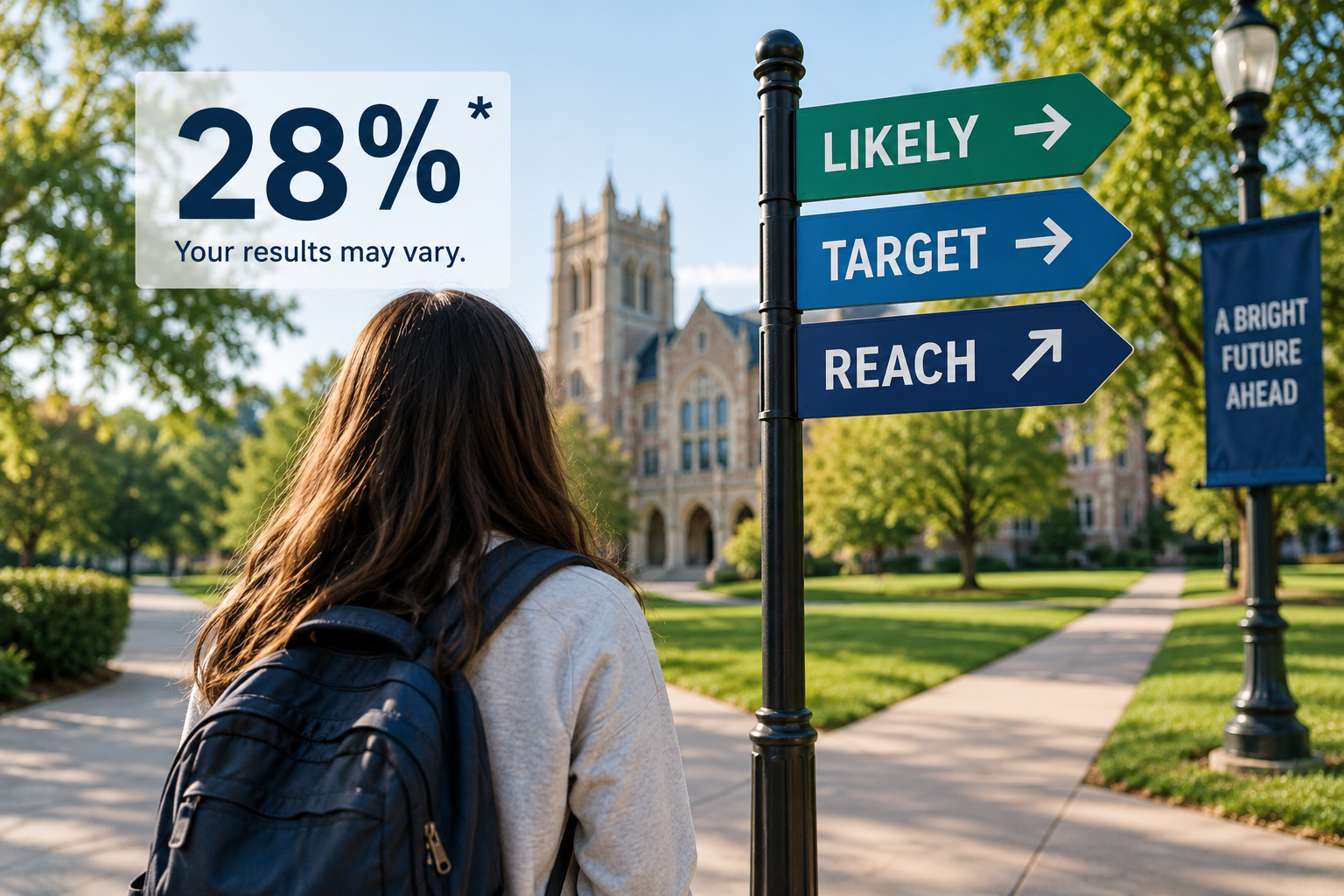
Student on a college campus looking at signs for likely, target and reach schools, illustrating how college acceptance rates and out-of-state admissions can affect a balanced college list.
A college's overall acceptance rate may not tell you YOUR chances of admission. For out-of-state applicants to public universities like UVA, UNC-Chapel Hill and UT Austin, the admissions landscape can look very different. Here's why residency matters and why understanding the numbers is essential to building a balanced college list.
You find a college you love. You Google the college acceptance rate: 28%. Not bad.
Then you check the admitted student profile. Your GPA is right there. Your course rigor looks good. Maybe your test scores are even toward the top of the range.
You think: “Great! This looks like a target school.” Not so fast.
One of the most misunderstood numbers in college admissions is the overall acceptance rate. At many competitive public universities, out-of-state college acceptance rates tell a very different story.
Your residency can have a significant impact on your college admissions chances, especially at popular state flagship universities such as UVA, UNC-Chapel Hill and UT Austin.
Because that 28% acceptance rate? May not be your acceptance rate.
In-State vs. Out-of-State College Admissions: Your Zip Code Matters
Public universities have a responsibility to educate students from their own state. Residents and their families support these institutions through state taxes, so many public universities give significant preference to in-state applicants.
Some states go even further, establishing policies that limit how many out-of-state students their public universities can enroll. That means the public university acceptance rate you see online may tell only part of the story.
And if you're trying to decide whether a college belongs in the likely, target or reach category on your college list, that's a pretty important part of the story!
UNC Out-of-State Admissions: Welcome to the 18% Club
Love the University of North Carolina at Chapel Hill but don't live in North Carolina? Here's a number you need to know: 18%.
UNC-Chapel Hill has historically limited non-North Carolina students to no more than 18% of its entering first-year class.
Think about that for a minute. As an out-of-state applicant, you aren't simply competing within UNC's overall applicant pool. You're competing for a relatively small portion of the freshman class alongside talented applicants from 49 other states and around the world.
Suddenly that Carolina blue sweatshirt feels a little more competitive, doesn't it?
This is exactly why looking only at a college's overall acceptance rate can lead families to underestimate just how selective a school may be for their particular student.
UT Austin Out-of-State Admissions: Everything's Bigger in Texas…Including the Competition
The University of Texas at Austin is another school where the overall admission numbers don't tell the whole story.
Texas has an automatic admission policy for certain highly ranked students graduating from Texas high schools. Beginning with the Fall 2026 entering class, eligible Texas students generally need to rank in the top 5% of their graduating class to qualify for automatic admission to UT Austin.
Those Texas students fill a significant number of seats.
Then add the enormous number of students from Texas, across the country and around the world who want to be Longhorns.
For an out-of-state applicant, UT Austin admissions can therefore be far more competitive than the university's overall acceptance rate suggests.
You can have the GPA. You can have the rigor. You can have terrific activities. You can even have test scores above the published averages.
And UT Austin may still be a reach. That's not pessimism. That's smart college-list building.
UVA Out-of-State Acceptance Rate: Another Reality Check
The University of Virginia is another perfect example of why residency matters in college admissions.
UVA maintains a student body with a substantial majority of Virginia residents. Roughly two-thirds of its undergraduate students are Virginia residents, leaving considerably fewer spaces for students applying from outside the Commonwealth.
In recent admission cycles, the UVA out-of-state acceptance rate has been roughly 10–13%. Read that number again. 10–13%. That's highly selective territory.
So when a strong student says, “But my GPA is above UVA's average,” that doesn't mean they shouldn't apply. Absolutely apply if UVA is a great fit! But we're also going to recognize UVA for what it is for most out-of-state students: a reach.
And then we're going to make sure the rest of the college list is balanced accordingly.

Get Guidance for Your College Journey
College Trek Consulting sends out tips and resources for navigating the college journey.
College Acceptance Rates Need an Asterisk
Sometimes I wish college acceptance rates came with a giant asterisk: Acceptance Rate: 27%* Your results may vary. Because your actual college admissions chances can depend on much more than the number that pops up in a Google search.
They can depend on:
Where you live
Your intended major
Whether you're applying directly to business, engineering, nursing or another highly competitive program
The rigor of your high school curriculum
Your GPA
Test scores, when considered
Early Action, Early Decision or Regular Decision
Institutional priorities
Special admission programs or state mandates
And just how competitive that year's applicant pool happens to be
That's why two students with nearly identical academic profiles can have very different admissions odds at the same university. And it's why categorizing colleges simply by their overall acceptance rates can result in a college list that isn't nearly as balanced as it appears.
Reach, Target or Likely? This Is Where College Admissions Strategy Matters
When I build college lists with my students, I'm not simply asking whether their GPA falls within a college's published range. I'm looking at the bigger picture.
Is this actually a likely school for this student?
Is it really a target?
Or is there something hiding behind that overall acceptance rate that makes it a reach?
Residency is one factor, but major, program selectivity, institutional priorities and application strategy can all change the admissions landscape. Sometimes we discover that a college a family thought was a target is actually a reach. And sometimes we uncover fantastic colleges a student hadn't considered where their chances, and opportunities may be much stronger.
That's part of building a balanced college list.
Know the Terrain Before You Start the Trek
There is absolutely nothing wrong with having reach schools on your college list. Dream big! Apply to the university whose sweatshirt has been hanging in your closet since eighth grade.
But don't build an entire college list out of reaches disguised as targets.
A strong college list should include schools you would genuinely be excited to attend across the likely, target and reach categories.
As an independent educational consultant, this is one of the areas where I spend a great deal of time with my students. At College Trek Consulting, we dig beyond the headline acceptance rates to understand the admissions landscape for the individual student, their academics, interests, major, residency, goals and priorities.
Because finding colleges isn't just about asking: “Can I get in?” It's also about asking: “Is this a good fit for me, and does my college list give me realistic options that I'd actually be excited to attend?”
That's the difference between simply making a list of colleges and developing a thoughtful college admissions strategy.
And just like any good trek, the journey is a whole lot easier when you understand the terrain before you start climbing.
Start your journey.
Gail Nichols, Independent College Consultant for over 12 years. Helping students to find their college is my passion.

Work With Us
College Trek Consulting offers programs for families navigating the college process. Get in touch to discuss your plan.